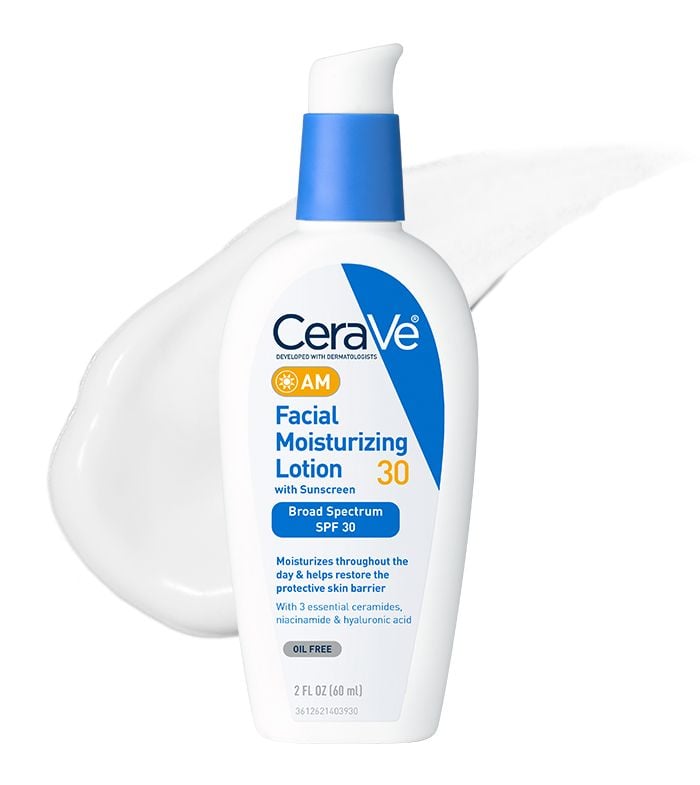
Is CeraVe AM Facial Moisturizing Lotion SPF 30 Reef Safe?
Not by the law. Allowed in 1 of 9 places we track. See why
- Not allowed: Hawaii
- Not allowed: Maui County
- Not allowed: Hawaiʻi County
- Not allowed: U.S. Virgin Islands
- Not allowed: Palau
- Allowed: Aruba
- Not allowed: Guam
- Not allowed: Northern Mariana Islands
- Not allowed: Thailand
CeraVe AM Facial Moisturizing Lotion SPF 30 is allowed under the sunscreen laws of Aruba, but not in Hawaii statewide, Maui County, Hawaiʻi County (Big Island), the U.S. Virgin Islands, Palau, Guam, the Northern Mariana Islands and Thailand's national parks. It combines chemical and mineral UV filters: homosalate 10%, octinoxate 5%, octisalate 5%, octocrylene 2% and zinc oxide 8%. It is a broad-spectrum facial sunscreen lotion made by CeraVe (L'Oréal USA Products, Inc.) and is not water resistant. Its FDA National Drug Code (NDC) is 49967-346.
Sizes: 2 fl oz · 3 fl oz
Where CeraVe AM Facial Moisturizing Lotion SPF 30 is allowed
| Location | Verdict | Why |
|---|---|---|
| Hawaii (statewide) | Not allowed | Octinoxate: banned by name. |
| Maui County (Maui, Molokaʻi, Lānaʻi) | Not allowed | Homosalate, octinoxate, octisalate and octocrylene: not permitted actives (mineral only). |
| Hawaiʻi County (Big Island) | Not allowed | Homosalate, octinoxate, octisalate and octocrylene: not permitted actives (mineral only). |
| U.S. Virgin Islands | Not allowed | Octinoxate and octocrylene: banned by name. |
| Palau | Not allowed | Octinoxate, octocrylene, homosalate, octisalate and phenoxyethanol: banned by name. |
| Guam | Not allowed | Octinoxate and octocrylene: banned by name. |
| Northern Mariana Islands (CNMI) | Not allowed | Octinoxate: banned by name. |
| Thailand (all national parks) | Not allowed | Octinoxate: banned by name. |
| Aruba | Allowed | No restricted ingredients found. |
Guidance and repealed rules (4)
| Mexico: federal marine protected areas (e.g., Isla Mujeres, Punta Cancún & Punta Nizuc) | Against guidance | Homosalate, octinoxate, octisalate and octocrylene: not mineral actives. |
| Bonaire (Bonaire National Marine Park) | Against guidance | Octinoxate: on the avoid list. |
| U.S. National Parks with coral reefs (NPS guidance) | Against guidance | Octinoxate: on the avoid list. Homosalate, octisalate and octocrylene: not mineral actives. |
| Key West, Florida | No rule in force | Octinoxate: banned by name. |
CeraVe AM Facial Moisturizing Lotion SPF 30 active ingredients
| Ingredient | Amount | Type |
|---|---|---|
| Homosalate | 10% | Chemical |
| Octinoxate | 5% | Chemical |
| Octisalate | 5% | Chemical |
| Octocrylene | 2% | Chemical |
| Zinc Oxide | 8% | Mineral |
CeraVe AM Facial Moisturizing Lotion SPF 30 inactive ingredients
WATER, NIACINAMIDE, CETEARYL ALCOHOL, GLYCERIN, PROPANEDIOL, DIMETHICONE, BEHENTRIMONIUM METHOSULFATE, BHT, CERAMIDE NP, CERAMIDE AP, CERAMIDE EOP, CARBOMER, TRIETHOXYCAPRYLYLSILANE, TRIETHYL CITRATE, SODIUM LAUROYL LACTYLATE, SODIUM HYALURONATE, CHOLESTEROL, ALUMINUM STARCH OCTENYLSUCCINATE, PHENOXYETHANOL, HYDROXYETHYLCELLULOSE, HYDROXYACETOPHENONE, CAPRYLYL GLYCOL, TRISODIUM ETHYLENEDIAMINE DISUCCINATE, PHYTOSPHINGOSINE, XANTHAN GUM, BENZOIC ACID
Highlighted ingredients are regulated somewhere; red ones are restricted in at least one location we track. Dotted ones are listed below.
Fragrance allergens, essential oils and alcohol
None of the 80 fragrance allergens on the EU list appear on this label, and it lists no fragrance, essential oil or drying alcohol.
The EU requires these allergens to be named on cosmetic labels above 0.001% in leave-on products (Regulation 1223/2009, Annex III). They can cause skin reactions in people who are sensitized; they don’t affect whether a sunscreen is legal anywhere we track.
Note: SPF face moisturizer. The brand page lists only four actives (Homosalate 10%, Octinoxate 5%, Octocrylene 2%, Zinc Oxide 8%) and omits Octisalate 5%, which appears on the FDA DailyMed label (setid 7d9e8c07-d295-4c8e-a52f-bdb509dc489b, effective 2025-03-27) and on the Costco and CVS listings; actives here follow DailyMed. Inactive list from the brand page; the DailyMed list also includes sodium phosphate, disodium phosphate and polysorbate 60. DailyMed says to use a water resistant sunscreen if swimming or sweating. A bilingual (Canadian) DailyMed label (setid 92029fdf-839e-4591-bf95-a439528c2613) has the same actives. Sizes from the brand product tag (2 fl oz) and DailyMed packaging (89 mL).
Common questions about CeraVe AM Facial Moisturizing Lotion SPF 30
Is CeraVe AM Facial Moisturizing Lotion SPF 30 reef safe?
“Reef safe” isn’t a regulated label claim, so we answer by law instead. It is allowed under the sunscreen laws of Aruba, but not in Hawaii statewide, Maui County, Hawaiʻi County (Big Island), the U.S. Virgin Islands, Palau, Guam, the Northern Mariana Islands and Thailand's national parks.
Is CeraVe AM Facial Moisturizing Lotion SPF 30 legal in Hawaii?
Under Hawaii’s statewide law (Act 104, which bans oxybenzone and octinoxate) it is not allowed because it contains octinoxate. In Maui County (Maui, Molokaʻi, Lānaʻi), which allows only mineral sunscreens, it is not allowed because it contains homosalate, octinoxate, octisalate and octocrylene, and Maui’s rule covers using it there, not just selling it. In Hawaiʻi County (the Big Island), which has a mineral-only rule for sales, it is not allowed. Oʻahu and Kauaʻi have no county rule, so only the statewide law applies there.
Where is CeraVe AM Facial Moisturizing Lotion SPF 30 not allowed?
Hawaii statewide: it contains octinoxate, which is not allowed there. Maui County: it contains homosalate, octinoxate, octisalate and octocrylene, which are not allowed there. Hawaiʻi County (Big Island): it contains homosalate, octinoxate, octisalate and octocrylene, which are not allowed there. The U.S. Virgin Islands: it contains octinoxate and octocrylene, which are not allowed there. Palau: it contains octinoxate, octocrylene, homosalate, octisalate and phenoxyethanol, which are not allowed there. Guam: it contains octinoxate and octocrylene, which are not allowed there. The Northern Mariana Islands: it contains octinoxate, which is not allowed there. Thailand's national parks: it contains octinoxate, which is not allowed there.
Does CeraVe AM Facial Moisturizing Lotion SPF 30 contain oxybenzone?
Yes. It contains octinoxate 5%. Oxybenzone and octinoxate are banned in Hawaii and most other places with a sunscreen law.
Is CeraVe AM Facial Moisturizing Lotion SPF 30 a mineral or chemical sunscreen?
Both. It combines mineral (zinc oxide 8%) and chemical (homosalate 10%, octinoxate 5%, octisalate 5% and octocrylene 2%) UV filters, so it does not meet mineral-only rules.
Is the zinc oxide in CeraVe AM Facial Moisturizing Lotion SPF 30 non-nano?
Its Drug Facts ingredient list doesn’t state particle size, and US labels aren’t required to. Many brands make non-nano claims elsewhere on the pack or website. No sunscreen law we track regulates nano particles.
Is CeraVe AM Facial Moisturizing Lotion SPF 30 water resistant?
No. It makes no water-resistance claim, so it isn’t meant for swimming or heavy sweating. Use a water-resistant sunscreen for time in the water.
What is the NDC for CeraVe AM Facial Moisturizing Lotion SPF 30?
CeraVe AM Facial Moisturizing Lotion SPF 30 is listed with the FDA under National Drug Code 49967-346. The NDC identifies this sunscreen on its FDA drug label (DailyMed); package sizes carry longer package NDCs.
Alternatives to CeraVe AM Facial Moisturizing Lotion SPF 30 for Hawaii statewide, Maui County, Hawaiʻi County (Big Island), the U.S. Virgin Islands, Palau, Guam, the Northern Mariana Islands and Thailand's national parks
Mineral sunscreens from other brands, allowed in all 8 places, ranked by label: water resistance, SPF 30–50, broad spectrum, no listed fragrance. How we rank

Daily Moisturizer SPF 30

Thinksport SPF 50 Clear Zinc Face Sunscreen

SPF 30 Mineral Facial Sunscreen

Sheer Face Mineral SPF 50 Sunscreen Lotion